
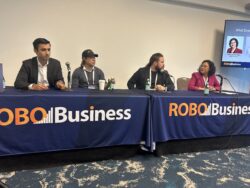
Key Takeaways from the RoboBusiness panel.
- Bootstrap where you can. Every dollar saved is runway earned.
- Test with users early. Real feedback beats elegant code.
- Build credibility, not just code. Your story must resonate beyond engineers.
- Lead with purpose. Tech for good is a strategy that opens doors.
- Know when to hire. The right salesperson or operator can unlock your next stage of growth.
- AI is a tool, not a ticket. Use it to make your product better, not to rebrand your company.
Reaching the first million in revenue is a milestone that most startups celebrate. But for robotics founders, it’s less a finish line and more a proving ground — where prototypes meet production and passion turns into process.
“This isn’t just about building technology,” said moderator Parna Sarkar-Basu, founder of B&B Consulting. “Starting a robotics company takes a different level of courage. You’re dealing with long development cycles, regulatory hurdles and now tariffs layered on top of it.”
The panel, part of the Beyond One Million series, brought together three founders whose companies have recently crossed that milestone. Each shared what scaling in robotics really looks like — from building prototypes in basements to hiring teams that can think beyond the founder.
Solve problems that matter
Despite operating in three different industries – biotech, solar and medtech – each founder’s journey began with a mission rooted in purpose. They chose robotics not for novelty but because existing solutions have failed their users.
- Chase Olle, founder of Robot on Rails, built his first lab automation robot in his parents’ basement after realizing scientists were still performing repetitive tasks manually.
- Jay Wong, founder of Luminous Robotics built 4,000-pound robots that install solar panels, to tackle one of the world’s most urgent infrastructure challenges: decarbonization and the explosion of energy demand from AI data centers.
- Jayiesh Singh, co-founder of Able Innovations, developed a robotic platform to move patients safely, after watching nurses, including his mother, suffer chronic injuries from manual patient handling.
“There’s a common theme here,” said Sarkar-Basu. “All of you are talking about tech for good. You’re solving problems that make a real, positive impact on people and the planet.”
Define what the first million means
While the milestone is celebrated across industries, its implications differ sharply in robotics.
For Olle, who bootstrapped his company, $1M is simply a burn, the bandwidth to keep building.
For Wong, it equates to a couple of robots in the field.
For Singh, selling into hospitals requires years of pilots, regulatory clearance and validation before revenue even appears.
Build the MVP, prioritize scrappy execution over perfection
Robotics founders do not have the luxury of cheap iteration. Their paths to a functional MVP were defined by resourcefulness.
Olle’s early hack was simple: free rent. “If you’re building robots, you need full-time focus. Free rent buys you time.”
Wong convinced vendors to lend him equipment, the first one for free while coding the early versions himself.
Singh balanced consulting work with non-dilutive grants to finance development until he had a prototype worthy of a hospital pilot.
The common advice is build fast, test early, and learn in the field. As Olle put it, “The first version doesn’t need to be perfect. It just needs to prove value.”
Shift from builder to leader
As companies pass the $1M mark, the real shift isn’t operational, it’s personal. CEO mindset becomes the biggest lever for growth.
“You go from iterating to committing,” Singh said. “When you decide, ‘this is a product,’ everything changes — uptime, throughput and service expectations.”
Olle added that credibility matters as much as capability. “Investors and customers don’t want to hear about convolutional neural nets,” he joked. “They want to know what problem are you solving for me?”
Wong framed building the company like a jigsaw puzzle, where product, storytelling and finance must align. “Each breakthrough fuels the next — product, marketing, hiring. It’s all one flywheel.”
Use AI as a tool, not a hype strategy
Although AI dominated investment headlines in 2025, the founders warned against leaning on the buzzword alone.
Singh described AI as “an enabling technology” that accelerated product development and allowed smaller teams to achieve capabilities once reserved for much larger R&D budgets.
Wong framed it as a driver of gross margins, not marketing: “If autonomy makes a robot more valuable or less expensive to deploy, customers will pay for it. If not, they won’t.”
Olle pointed out the distinction between general AI and today’s surge in NLP and LLMs: “AI isn’t new. What’s exciting now is natural language interfaces, which make it possible for novices to use advanced systems. That’s what customers notice.”
Prepare for industry headwinds
Each founder faces different market realities:
- Solar robotics is booming, driven by AI-powered data center growth but constrained by tariffs and tax credit shifts.
- Healthcare robotics is rising alongside an aging population and staff shortages yet must navigate tight budgets and regulations.
- Lab automation is contending with a “biotech winter,” where R&D cuts and investor skepticism are squeezing early-stage innovation.
Their response: diversify manufacturing, find sustainable business models and focus on solving customers’ most urgent problems.
Closing Thought
As the session wrapped up, Sarkar-Basu reiterated the shift founders must embrace as their companies grow.
“Once you get to that million and beyond, you go from being a builder to being a leader. That’s the pivot point.”
She added that the ability to step back and shape how the world sees the company, not just how the company sees itself, often determines whether a startup can break beyond early traction.
“Credibility is just as critical as capability.”