
 AI is often presented as the holy grail. The answer to all problems.
In reality, we still need humans in the loop, people who can understand situations, exercise judgment and step in when needed.
We shouldn’t forget that customers and patients are people. They have certain expectations in today’s experience economy. A fast answer isn’t always enough.
The business consequences are clear. A Genesys survey found that 85% of consumers had spent less or stopped purchasing from a brand after a poor experience. And, according to Gartner, 87% of customers say companies using generative AI for customer service must give them a way to reach a human.
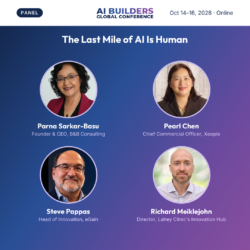
That expectation anchored the panel I moderated at the AI Builders Global Conference. I was joined by Steve Pappas of eGain, Richard Meiklejohn of Lahey Clinic and Pearl Chen of Xoople. And together we shared a range of perspectives, from customer experience and patient care to earth data and role of tech and humans in today’s experience economy.
Here are the key takeaways from the session.
1. Know what people need before you build. Building an AI tool is becoming easier. Understanding what people need still takes listening. Customers approach the same problem with different expectations. Patients have different levels of comfort with technology. Involving users and frontline employees early helps organizations understand those differences before investing in a solution people may struggle to use.
2. Better answers start with better information. Connecting AI to a mountain of documents does not make those documents reliable. Outdated policies and disconnected repositories can undermine an otherwise promising deployment. AI may retrieve information that matches a question without recognizing that it has been superseded. Companies need to establish which information is current before customers depend on the answers.
3. Don’t make customers start over. We’ve all experienced it. Explain a problem to a bot, get transferred, then explain everything again. A “warm handoff” preserves context, personalizes the transition and ideally connects the AI interaction to systems such as Epic, rather than requiring the person to repeat information. This provides the right information to the person who is continuing the conversation. Also, tell customers when they are interacting with AI and make reaching a person easy. The transfer should move them closer to a resolution.
4. AI provides data for people to make decisions. Earth observation data and AI can help transportation agencies identify changes around roads and bridges across large, remote areas. People still need to interpret the findings, consider local conditions and decide what action makes sense for the community. More information creates value when someone has the context and judgment to act on it.
5 Measure AI’s impact on people. Minutes saved are only part of the return on investment. Compare results from people working independently, AI working independently and people using AI. Measure accuracy, resolution and satisfaction alongside speed. In healthcare, documentation tools that reduce administrative work can also improve clinicians’ working lives. That benefit deserves attention, too.
6. Keep learning and stay close to people. For professionals navigating their careers, the advice was practical. Learn to work with AI, stay curious and build relationships. Develop the judgment to question an answer and understand its implications. Get closer to customers. Whatever technology we use, we are ultimately serving people.
Steve: Always think about reinventing yourself. Your value lies in knowing what to do with AI and caring about the person on the other end.
Richard: If you want to grow in your profession, make human connections, connect with your peers and find opportunities to collaborate and learn.
Pearl: Learning is a lifelong journey. And the people who continue to excel are those people who continue to learn and challenge themselves.
Parna: We serve customers and interact with patients. We are all human. We need trust, empathy and timely responses.
Bottomline: The value of AI lies in the experience it creates for the people we serve. Business leaders must know where it can improve that experience and when human judgment needs to take over. Hence, the last mile of AI must remain human.
XXX
Parna Sarkar-Basu is the founder of B&B Consulting and host of Beyond One Million podcast.